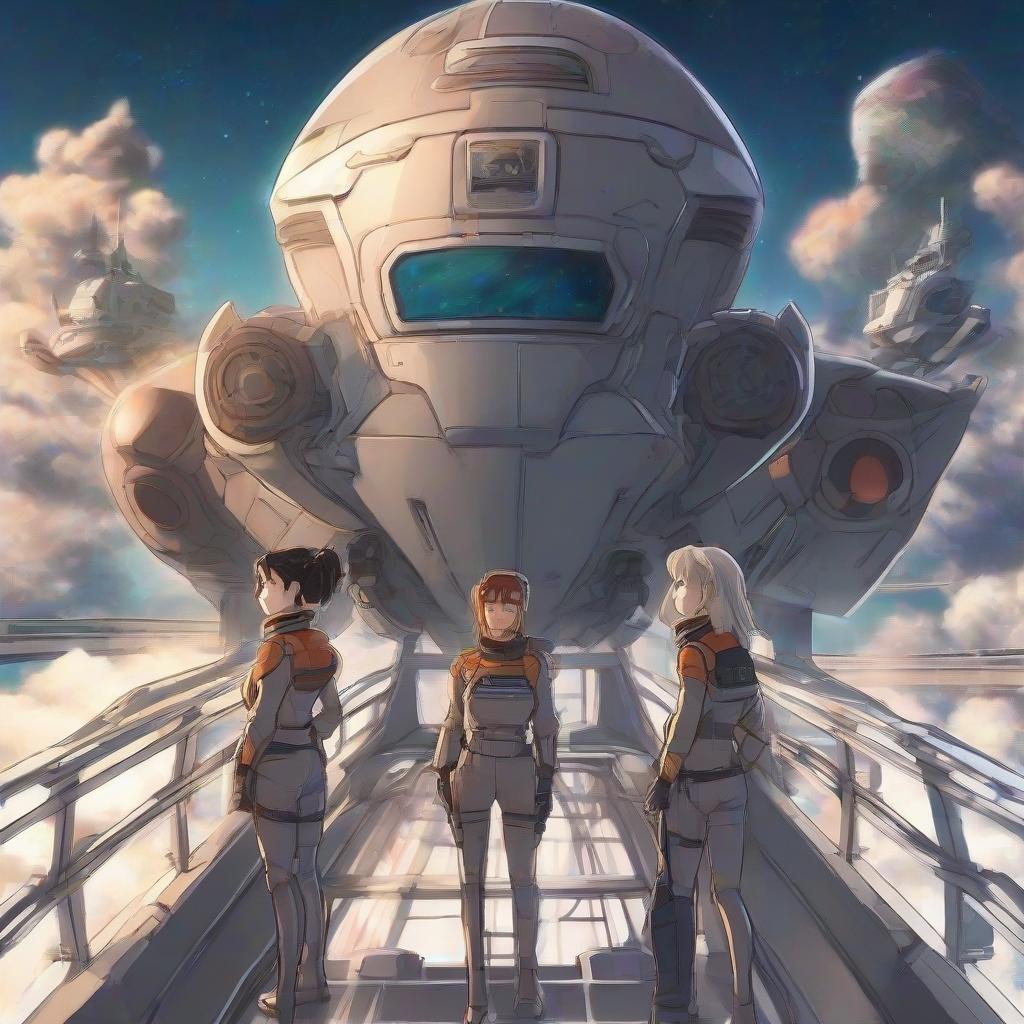
Reborn as a Space Mercenary: A Disappointing Light Novel Journey
The light novel series Reborn as a Space Mercenary presents itself as an exciting tale of an ordinary man thrust into an extraordinary interstellar life. However, after diving into its first two volumes, the reality falls far short of this promise. Rather than delivering a thrilling power fantasy, the series offers a bland, uninspired experience marked by hollow characters, questionable narrative choices, and a general lack of genuine engagement. It is a narrative that struggles to find its footing, ultimately becoming a forgettable addition to the science fiction genre.
A Protagonist Lacking Depth
Satoru Takahiro's transformation into Captain Hiro is meant to be the core of this adventure, yet his character remains remarkably underdeveloped. Prior to his transmigration, Satoru is described as a generic office worker whose only notable traits are his love for soda and his skill in Stella Online. This thin backstory provides no foundation for his new persona. He adapts to a dangerous, galaxy-spanning life with alarming ease, showing little confusion or struggle. Pirates become mere obstacles to dispatch without moral qualms, akin to video game enemies.
As Hiro, he acts as a mere receptacle for glory. He acquires an ultra-powerful starship, the Krishna, and effortlessly overcomes challenges. The problem intensifies in Volume 2 when Hiro begins to display more defined personality traits, which are unfortunately quite repulsive. His casual dismissal of concerns regarding his human girlfriend Mimi's potentially young age, rationalized by a galactic age of consent, is deeply unsettling. Similarly, his decision to keep his space elf girlfriend Elma indentured to him for convenience paints him not as a heroic figure, but as a morally questionable individual whose effortless victories feel undeserved and unearned.
The Unfulfilled Power Fantasy
A power fantasy relies on a strong contrast between a character's past struggles and their newfound abilities and success. Reborn as a Space Mercenary fails precisely here. Without a robust portrayal of Satoru's mundane, unsatisfying life, there is no meaningful comparison to Hiro's grand galactic adventures. The narrative merely assumes that becoming a "galaxy-trotting badass" is inherently appealing. There is no exploration of why piloting the Krishna is more satisfying than his old job, or why he savors the companionship of Elma and Mimi beyond generic notions of loneliness.
This lack of specific friction or emotional depth prevents the power fantasy from resonating. The triumphs feel unearned because the protagonist has no discernible journey of growth or overcoming. Everything comes too easily, stripping away any sense of accomplishment or genuine reward. The story ticks off generic power fantasy checkboxes without the necessary emotional or narrative craft to make them engaging.
Problematic Relationships and Timid Exploitation
The relationships Hiro forms with Mimi and Elma are particularly troubling. Both women become romantically involved with him after he "saves" them from dire circumstances, creating unequal power dynamics that the narrative touches upon but then bizarrely shies away from exploring fully. For instance, Elma faces a grim future of sexual violence before Hiro saves her by paying her debt, essentially indenturing her to him. When she subsequently offers herself to him, the depiction is abrupt and almost chaste, despite preceding paragraphs hinting at explicit dangers.
This hesitancy to fully commit to either a genuine emotional exploration of these complex dynamics or an unashamed embrace of exploitation leaves the narrative feeling strangely timid and inconsistent. If the series aimed to be a sleazy fantasy centered on unequal power dynamics, at least it would possess a clear, if controversial, identity. Instead, it vacillates, resulting in a blandness that lacks even the courage to own its own suggestive elements. The frequent use of thuddingly obvious innuendo only highlights this narrative indecisiveness.
A Generic Galaxy and Supporting Cast
Beyond its protagonist and his problematic relationships, the world of Reborn as a Space Mercenary is equally uninspired. Elma, the space elf, is a capital-T Tsundere archetype, while Mimi is so undeveloped that Hiro has to suggest interests for her. Other supporting characters are similarly archetypal, offering little unique personality.
The galaxy itself feels like a stock backdrop, presenting "power players and complications" as little more than surface-level dressing. Any potentially interesting details are glossed over. The few sparks of life appear as direct quotes or homages to superior science fiction works, serving only to remind the reader of better alternatives. This derivative approach underscores the overall lack of originality and thought put into the series' world-building.
Conclusion: A Bland, Forgettable Read
Reborn as a Space Mercenary Volume 1-2 ultimately falls flat. It lacks compelling characters, a well-executed power fantasy, and a thoughtfully constructed world. The narrative's attempts at indulgence are oddly timid, and its protagonist's evolution from cipher to slimeball makes engagement difficult. With numerous superior science fiction and fantasy options available, this light novel offers precious little to savor. It's a bland, uninspired experience earning a D- grade, proving to be a forgettable use of time.