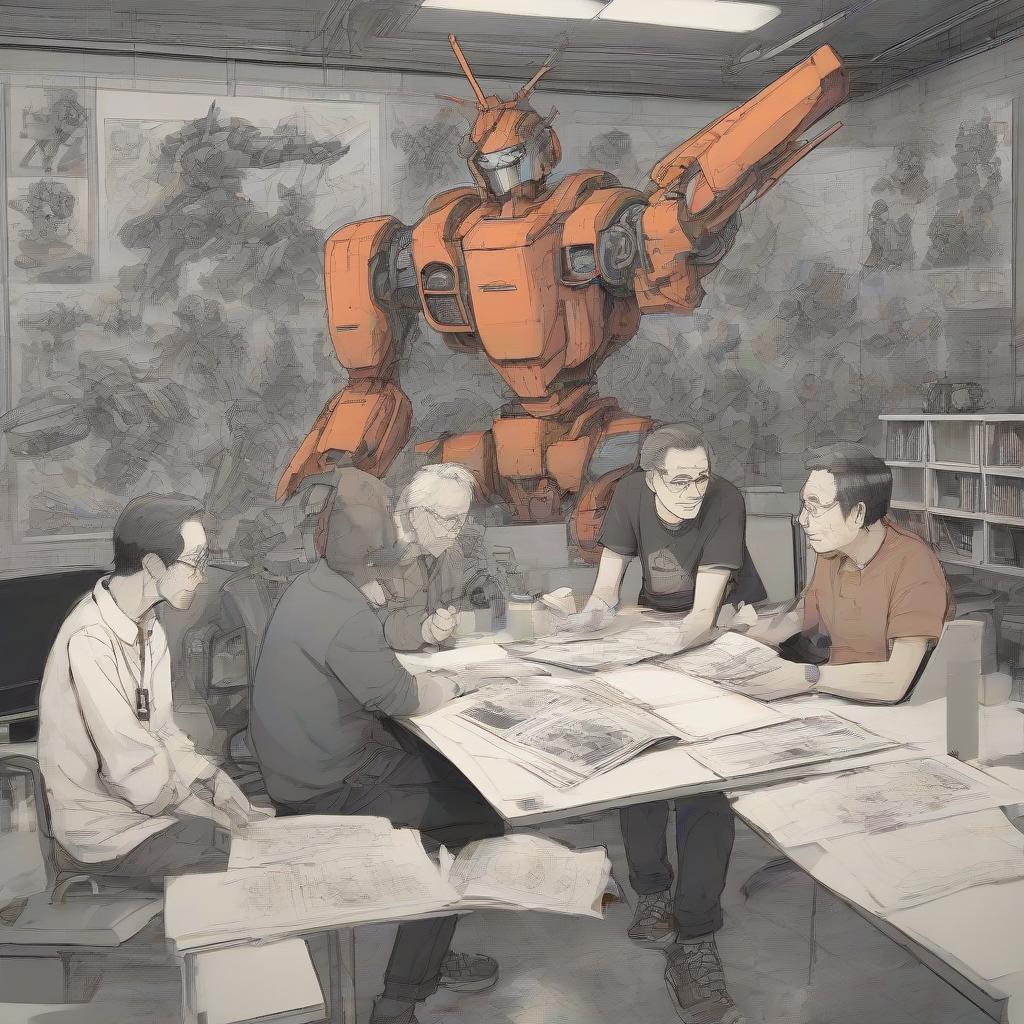
A star-studded panel gathered to discuss Yoshitaka Amano's latest anime endeavor, ZAN, offering a deep dive into the history, current state, and future of Japanese animation. Featuring film producer Hiroaki Ikegami, Armored Trooper Votoms creator Ryosuke Takahashi, producer Tatsuyoshi Matsumoto, and Mobile Suit Gundam 0083: Stardust Memory mechanical director Toru Yoshida, the discussion illuminated the industry's evolution through the lens of its most impactful creators. Though Moriyasu Taniguchi was absent due to injury, his influence permeated the conversation, especially regarding the "Robot Revolution" and the enduring legacy of mecha anime.
The Robot Revolution's Roots
The panel's journey began with a nostalgic look at the "Robot Revolution," focusing on classics like Armored Trooper Votoms and Fang of the Sun Dougram. Takahashi openly shared his admiration for Gundam, which in turn inspired Dougram. He recounted the creative hurdle of making "sweaty military uniforms look cool," a unique challenge at the time, stating, "I think I was able to create my own uniqueness to it." Toru Yoshida, who made his "Robot Works" debut with Dougram, added insights into his early career, where he initially drew only what was instructed. This experience fueled his desire for more creative input, which he found in Blue Comet SPT Layzner, where he contributed to mecha designs and movement drafts. He highlighted the difficulty of envisioning complex movements, like wings, without prior examples. Yoshida contrasted his early, more constrained work on Dougram with the artistic freedom he experienced working on Votoms at 22, showcasing the dynamic interplay between strict expectations and creative flexibility in anime production.
Lasting Legacy: Anime R and Its Students
Tatsuyoshi Matsumoto underscored the profound and lasting influence of Yoshida and Takahashi on Japanese animation. He lauded Takahashi's keen eye, noting how the "robots were flushed with realism," a quality that deeply resonated with him as a teenager. The impact of Dougram and Votoms was so significant that it inspired a generation of young animators, many of whom sought to join Moriyasu Taniguchi's renowned company, Anime R. This esteemed group of "students" includes names now iconic in their own right: Hiroyuki Okiura of Ghost in the Shell, Kazuchika Kise of Patlabor, Takahiro Kimura of Code Geass, Kazuaki Mori of Pokemon, Masahide Yanagisawa of Rurouni Kenshin, Seichi Nakatani of Gundam, and Asako Nishida of Love Live! School idol project. Matsumoto stressed that while this lineage is a well-known fact in Japan, it remains largely unrecognized in the U.S. and Europe. He emphasized the crucial role these panelists and Taniguchi played in shaping the contemporary anime landscape, noting even Shinya Ohira of Studio Ghibli is a fan of Anime R's works, Layzner and Votoms.
Reflecting on the Golden Age
Takahashi took a moment to reflect on anime's storied past, recalling his time alongside the legendary Osamu Tezuka. He painted a vivid picture of the intense work schedules during the "Golden Age" of anime in the 1980s, where all-nighters were common, likening the collaborative environment to "forced labor" rather than mere work, a comment he delivered with a smile. Tezuka, a pioneer of the 30-minute animation revolution in Japan, was described as a "genius but a weirdo" who had no interest in accumulating wealth, a rare trait Takahashi believes would make him an anomaly in the U.S. However, Takahashi also offered a sobering warning about the perils of overwork. He pointed out that Tezuka, Shotaro Ishinomori, and Fujiko Fujio all passed away around the age of 60, urging caution: "If you work too much, you're going to pass early, so be careful."
Present Day Challenges and ZAN's Unique Approach
Transitioning to the present, Takahashi commented on the striking lack of change in the production environment for Japanese anime. Despite the exponential growth in the number of animated series since Astro Boy first aired in 1963, reaching approximately 370 broadcasts today, the number of animation staff has remained stubbornly stagnant at around 10,000 animators. He observed that roughly "80% are average animators and probably only 5% are at the top," a ratio that has persisted for six decades. While digitalization has streamlined certain processes, Takahashi noted that animators still spend "just the same amount of time" drawing. This revelation sets the stage for ZAN's unique approach: "With ZAN, we're going back to making everything by hand and showing what we can create from there." Yoshida echoed the sentiment, citing relentless scheduling and time constraints. He shared his experience of simultaneously working on up to 14 projects in his 30s, and currently juggling eight. He stressed that animators, regardless of their chosen medium, are compelled to work on multiple projects concurrently due to the sheer volume of demand.
Gazing into Anime's Future
As the panel neared its close, each speaker offered their vision for the future of the anime industry. Takahashi, who teaches animation at a college in Osaka, sees plenty of students interested in animation but hesitant to pursue it professionally due to its demanding nature. He invoked a Japanese proverb: "There's a Japanese proverb that says you'll become better at it the more you love it. Love it, then you can pursue it." From an artist's standpoint, Yoshida sees increasing prospects in 3D animation, yet hopes for a continued focus on the fundamental act of drawing, whether traditional or digital. He believes in simply translating one's inner vision onto paper, irrespective of the tool.
Matsumoto believes the true Golden Age of Japanese animation spanned from approximately 1985 to 1992, with the 1988 film Akira serving as a defining masterpiece. He expressed skepticism that such an era could be replicated today. He noted that the all-star animators of that period, then in their 20s, now lead the animation world in their 40s and 50s. Like Yoshida, Matsumoto juggles numerous projects and expressed immense relief that ZAN was completed. He humorously recounted finishing ZAN "on the airplane at 5 AM," just in time for the panel. Matsumoto confessed that he currently lacks the capacity to ponder the industry's distant future. His immediate focus is on making ZAN a final, powerful showcase for the Golden Age of Anime, bringing together the talents of Taniguchi-san's collaborators and students, including Cowboy Bebop's Takahiro Komori as the youngest member of this extraordinary team. Matsumoto sees ZAN as "potentially the last opportunity to share the era of the Golden Age of Anime. I concentrated on it as the last opportunity. I'm looking forward to this moment right now."
This panel offered a rare glimpse into the minds of anime legends, bridging the past, present, and the hopeful, yet challenging, future of an art form that continues to captivate audiences worldwide. ZAN stands poised not just as a new project, but as a monument to a golden era.