A New Dawn Anime Review: Stunning Art, Mixed Story
Yoshitoshi Shinomiya’s directorial debut, "A New Dawn," emerges as a visually captivating anime film that immediately distinguishes itself through its breathtaking artistry. Drawing from Shinomiya's rich background as a background artist for renowned works like Makoto Shinkai's "Your Name." and "Pompo: The Cinéphile," the film's visual language transcends its intimate narrative, offering an expansive and deeply immersive experience. The story centers on a group of young individuals reuniting in their hometown to complete the mythical "Shuhari" firework, a long-lost creation of their 330-year-old factory facing demolition. While the premise hints at familiar underdog drama, "A New Dawn" truly shines in its commitment to visual innovation, creating a hypnotic backdrop for its characters' journey.
Visual Splendor Takes Center Stage
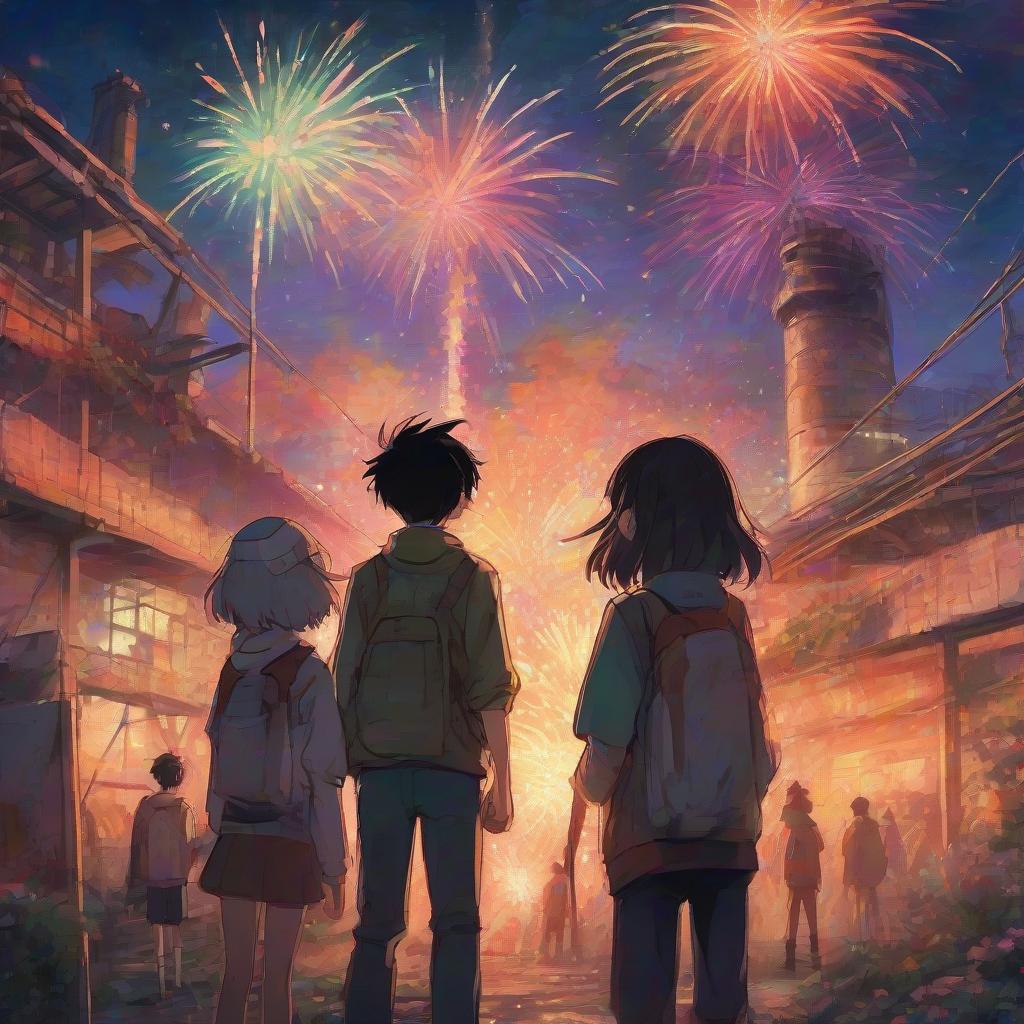
From its opening sequences, "A New Dawn" establishes a benchmark for visual excellence. The film's production design is nothing short of lush and hypnotic, showcasing a painterly aesthetic that immediately evokes Shinomiya's distinctive style. The background art, credited to Akiko Majima and Shinomiya himself, is dense with meticulous detail, rich with luminous colors, and imbued with illustrative textures that bring the countryside habitats and ramshackle living spaces to life. Unlike the photorealism often seen in contemporary anime, Shinomiya incorporates impressionistic touches, such as splotches of green paint for treelines or subtle shifts in background textures, sometimes veering into outright abstraction that underscores a character’s emotional state or movement through the environment. Every frame feels carefully crafted, telling a story through its visual composition, making it clear why the film earned an "A" for its art direction.
The visual inventiveness extends beyond static backgrounds, permeating "A New Dawn’s" various experiments with animation languages. One particularly charming sequence employs stop-motion animation using a cardboard diorama, with real human hands cleverly integrated to reflect a drunken character's distorted perspective. These creative choices underscore the film's artistic ambition and willingness to explore diverse animation techniques within its broadly "anime" aesthetic. Smaller, yet significant, details further set the film apart: occasional lineless artwork for character moments or the definition of rain through smudged black brushstrokes contribute to a unique visual identity. This consistent push for creative visual expression earns the animation a commendable "B+" grade, demonstrating a strong understanding of how to use the medium to its fullest.
A Narrative That Keeps Its Distance
Despite its undeniable visual strengths, "A New Dawn" struggles to maintain the same level of engagement in its screenwriting. The story, focusing on the pursuit of the fabled "Shuhari" firework, feels familiar in its premise but ultimately alienating in its execution. The core importance and majesty of the firework itself never fully crystallize for the audience, leading to a climax where its unraveling lacks the intended revelatory impact. The writing often obfuscates crucial details and character motivations, creating a sense of distance between the viewer and the on-screen events. Conversations sometimes feel circular, and the underlying stakes, despite the factory's impending demolition, don't always resonate with the emotional weight they should carry. This narrative approach contributes to the story receiving a "C" grade, as it struggles to anchor the audience amidst its otherwise captivating backdrop.
The characters, despite inhabiting beautifully crafted spaces, remain somewhat at arm's length. Their internal struggles and relationships, while present, aren't deeply explored enough to forge a strong emotional connection with the viewer. This emotional detachment prevents the film from fully capitalizing on the potential for an underdog story or a poignant tale of reunion and heritage. The allure of the background art and the design of their world are strong, but the people within it sometimes feel like sketches rather than fully realized individuals, making it challenging to invest wholeheartedly in their plight or their quest to complete the mythical firework.
Climactic Fireworks and Final Thoughts
"A New Dawn" almost manages to pull back its narrative shortcomings with its powerful climax. The detonation of the "Shuhari" firework serves as a magnificent visual spectacle, momentarily justifying the preceding circular conversations about its nature and origins. A painted streak of light launches into the sky, transforming into an otherworldly display that triples down on the film’s captivating visual exaggerations. This moment is a testament to the film's visual prowess, proving that when the artistry takes center stage, it can leave a lasting impression. The music, receiving a "B" grade, contributes effectively to these heightened moments, though it doesn't always stand out independently.
Ultimately, "A New Dawn" stands as a compelling, albeit flawed, directorial debut. Its primary strength lies in its unparalleled visual artistry, from the intricate linework and vibrant color choices to the masterful background art that paints a world rich with texture and imagination. These elements firmly establish Yoshitoshi Shinomiya as a visionary visual storyteller. However, the film's narrative struggles—its alienating character work, ambiguous plot points, and at times uneven rhythm—prevent it from reaching its full potential. While the visuals alone make it a worthwhile watch for animation enthusiasts, the story’s inability to fully engage the audience results in an overall grade of "B-", a fair reflection of a film that is brilliant in parts but uneven in its whole. It is a visual feast that leaves you hungry for a more deeply resonant emotional connection.