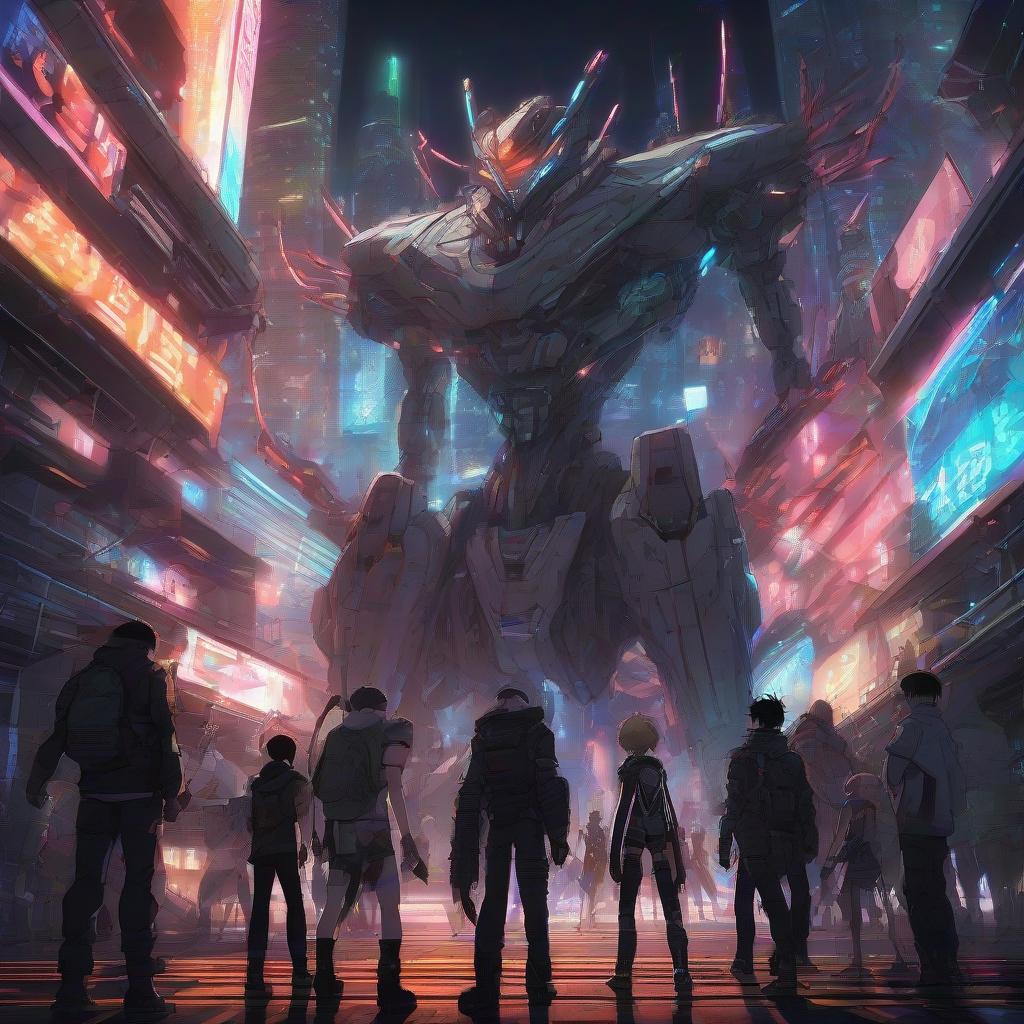
Digimon Beatbreak, with its initial dozen episodes, already established itself as a refreshing take on the beloved franchise, expertly weaving in the intricate concepts of cyberpunk fiction. While those early installments excelled in delivering largely episodic narratives, they only hinted at the deeper, overarching plot awaiting viewers. Episodes 13 through 24 mark the series' bold plunge into its first significant story arc, and despite a few minor stumbles, this stretch of Beatbreak brilliantly expands upon the show's foundational themes, cementing its place as one of the most compelling offerings in Digimon anime history.
The Rise of Tactics: A System Under Scrutiny
This compelling second arc thrusts the Glowing Dawn into direct conflict with Tactics, a Cleaner organization that operates with the rigid structure and ruthless efficiency of a paramilitary unit, its seventh squad being particularly distinguished. Their presence might initially seem an unusual fit within Beatbreak's futuristic aesthetic, yet it perfectly embodies the essence of strong cyberpunk storytelling: a profound critique of systems of control. In stark contrast to the Glowing Dawn, who champion autonomy and view their bonds as familial, Tactics members are indoctrinated into an ideology of strict discipline and unwavering efficiency. Deviations from orders or breaches in rank are met with severe physical repercussions. This oppressive framework fosters a ruthless mindset, making Tactics easy antagonists to oppose—whether they're disregarding children as mere collateral, complicit in human trafficking, or even hunting down their own deserters.
Foils and Inner Conflict: Character Depth
Crucially, the series doesn't merely paint Tactics as one-dimensional villains. Instead, it meticulously explores the individual suffering and complex motivations of each member within their harsh environment, using them as potent foils to our protagonists to amplify its social commentary. A prime example is Hotaruko, a young woman who joined Tactics out of economic necessity, aiming to uplift her family from poverty. This decision has ensnared her in a role that frequently forces moral compromises, breeding resentment towards Makoto, who seemingly enjoys a life of privilege and relies on others. However, as their interactions evolve, Makoto's inherent desire to shoulder shared burdens gradually inspires Hotaruko towards greater compassion.
Tomoro finds his counterpart in Raito, a cocky young man who prides himself on emotional suppression and absolute obedience to orders—a stark contrast to Tomoro's free-spirited nature and open heart. While Raito appears to be one of his team's coldest members, his demeanor is a product of his environment. Unlike Tomoro, who found a vital support structure in Kyo and the Glowing Dawn that empowered him to think independently, Raito is subjected to frequent abuse and punishment from his superior, Naito, whenever he falls short. Consequently, the more Raito clashes with Tomoro, the more his underlying envy for Tomoro's freedom surfaces, subtly influencing him to seek his own liberation. This astute social critique extends even to Klay Arslan, the arc's central antagonist. A suave capitalist and former royal whose nation was plundered of its resources, Arslan's relentless pursuit of wealth and power is driven by a burning desire to reclaim what was lost, mirroring the very societal forces that stripped him bare. This demonstrates the profound impact external forces have in shaping individual destinies. While Beatbreak's early episodes adeptly operated as solid cyberpunk, this arc's success in tackling these intricate themes elevates it to truly great cyberpunk media.
Minor Discord: Areas for Improvement
Despite its many triumphs, this impressive collection of episodes is not entirely without its minor caveats. While the parallels drawn between Tactics and the Glowing Dawn generally succeed in deepening our understanding of both sides, this analytical depth doesn't quite extend to Reina. Her pairing with the young boy Granit, whose family was tragically lost in a military conflict, focuses on Granit's journey out of a suicidal mindset. While Granit's character is handled with commendable sensitivity, Reina's role in his development does little to advance her own character arc, leaving her feeling comparatively underdeveloped even halfway through the series.
Additionally, given the predominantly dark and mature subject matter explored in these episodes, one particular installment featuring a Cleaner gang of mushroom-themed goofballs seeking revenge feels tonally out of place. While the episode offers decent entertainment and eventually provides these characters with a valid reason to persist, its inclusion within this otherwise serious stretch of the show makes it the weakest link. Lastly, while Beatbreak maintains a consistently high animation standard for a Digimon title, the absence of insert battle songs—a feature notably present in the initial episodes—until the very final episode of this cour is somewhat disappointing. This, coupled with the repetitiveness of some regular battle tracks, renders Beatbreak's musical score less memorable compared to other Digimon entries.
Conclusion: A Promising Future
Minor quibbles aside, DIGIMON BEATBREAK continues to operate at full throttle. The series masterfully navigates heavy subject matter, even by Digimon's own standards, presenting these complex topics with grace and making them comprehensible for younger audiences. This show stands as the most ambitious anime offering from the Digimon franchise in a considerable time. Should the latter half of the series maintain this impressive momentum, Beatbreak is poised to become one of its absolute strongest iterations.