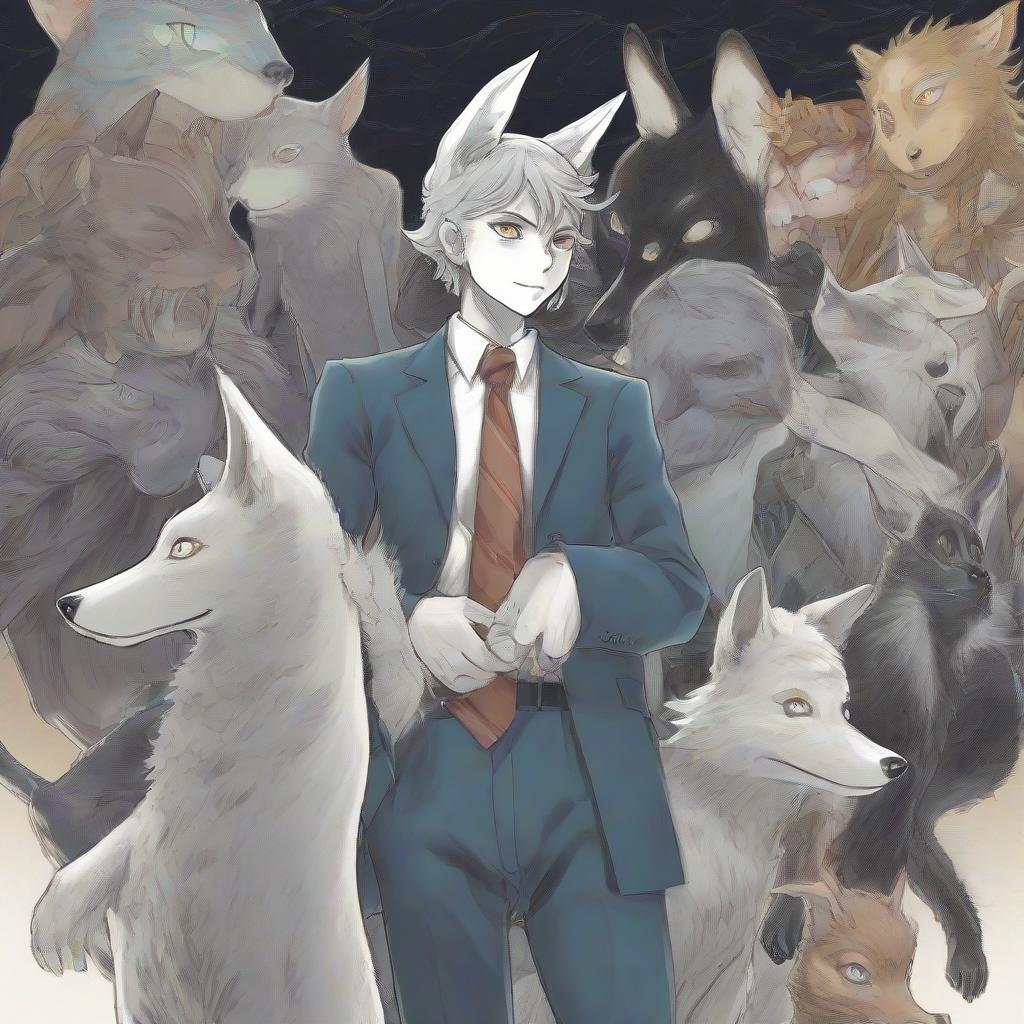
BEASTARS: A Deep Dive into Society's Wild Side
BEASTARS presents a world of anthropomorphic characters, a premise that, while increasingly common, rarely achieves the profound thematic depth found within this series. Using animal species as a powerful allegory for real-world societal divides, BEASTARS carves out a distinct narrative space. It avoids overly specific metaphors, instead leaning into the inherent animalistic nature of its inhabitants to craft a world uniquely its own. This approach broadens the applicability of its themes, allowing parallels to racism, classism, sexism, and various phobias to resonate universally, rather than being confined to particular human issues. The manga masterfully explores these complex ideas through the eyes of a character whose relative innocence starkly contrasts the twisted world around him.
Legoshi's Enduring Goodness
At the heart of BEASTARS is Legoshi, a character who embodies the essence of a "good boy." While capable of violence when pushed, he remains primarily a meek observer, given to deep introspection. His tumultuous relationship with Haru is a central pillar, showcasing his earnest attempts to reconcile aggressive and complicated feelings with a pure desire for connection across multiple story arcs. Even as he navigates his own primal instincts, Legoshi continually butts up against the hardened realities of society. This consistent thematic thread—Legoshi’s straightforward worldview clashing with the often cynical and nihilistic mentalities of the extended cast—is where the series truly shines. Unlike others who have adapted to the society's grim norms, Legoshi consistently questions, refusing immediate conformity. His emotional and physical interactions with the diverse characters he encounters are a highlight.
Expanding Horizons Beyond High School
The initial volumes of BEASTARS maintain a contained scope within Cherryton Academy, focusing on the dynamic trio of Legoshi, Haru, and Louis. However, with the resolution of the Shishi-gumi incident in volume five, the narrative gracefully expands. New classmates emerge, followed by adults, each offering their unique perspectives on survival and self-expression. Louis's journey stands out as particularly dynamic. We witness his ascent into various positions of power, from a privileged upbringing to leadership in the underworld, yet he consistently finds himself unfulfilled. His arc, marked by actions far more extreme than Legoshi's, remains tragically understandable, highlighting the pressures of his world.
The Societal Skeleton Revealed
Characters like Haru offer another perspective, acutely aware of her position as prey and embracing a fatalistic acceptance of her life's trajectory, choosing instead to make the most of it. Others seek unconventional relationships, professional or romantic, sometimes expressing these dynamics in deeply unsettling ways. Even encounters with characters who believe they possess pure intentions often carry a dark or melancholic undertone. While Legoshi is not entirely blameless, forced at times to engage with society on its own terms, his internal monologues—his feelings, his justifications—are endlessly compelling. The themes of societal decay become particularly poignant once Legoshi leaves the sheltered environment of school. He confronts adults who have endured for years what he is only just beginning to experience, creating a palpable sense that many once shared his innocence and hope before being inevitably broken down.
A Bleak Yet Balanced Narrative
Despite its often sad tone, BEASTARS sprinkles in moments of levity and comedy through dialogue and occasional slapstick. Yet, a pervading melancholic realism defines the series. Even as a definitive final villain emerges, they often serve as a dark mirror to Legoshi, representing what he might become without a driving sense of hope. Paru Itagaki does not shy away from the dead ends some characters face, nor does she offer an overly optimistic vision for the future. The series provides no easy solutions to its pervasive problems, a deliberate choice that contributes to its realistic portrayal of society. There’s an underlying suggestion that some unpleasant realities must be accepted for the greater good, however imperfect that good may be. Itagaki is a skilled writer, capable of contrasting an exaggerated world with profoundly grounded human emotions. Her ability to craft a series that leaves readers feeling satisfied, even without perfect resolutions, is commendable.
Narrative Loose Ends and Character Shifts
While the ending generally satisfies, some loose ends remain. This could be interpreted as a reinforcement of the theme that not all problems resolve neatly. However, certain plotlines and character introductions sometimes feel abrupt. Itagaki occasionally introduces elements out of nowhere that quickly become central to the main narrative. This might be a new character thrust into the spotlight or a crucial backstory revelation previously unhinted at. While this is characteristic of her writing style and often thematically consistent, ensuring the series never feels completely disorienting, the sheer volume of new elements introduced as the story progresses means some defining aspects of the series can get lost.
Haru, unfortunately, appears to be the most significant casualty of this expanded scope. Her appearances become noticeably less frequent over time, to the point where her existence occasionally fades from memory. This is problematic, considering her relationship with Legoshi is one of his primary motivations. Her cynical perspective is a vital counterpoint, making her reduced presence even more regrettable, as it diminishes the development of a crucial interpersonal relationship. One could argue Legoshi spends more time with Louis, a direction some might prefer, but it deviates from the story's initial emotional core.
A Striking and Expressive Art Style
On the artistic front, Itagaki's distinctive style is a major draw. Her designs are exaggerated and cartoony, sometimes reminiscent of Looney Tunes characters, yet always expressive. Even Legoshi, with his typically blank default expression, manages a remarkable range of emotions. Characters' body proportions can twist into wonderfully exaggerated forms. The sketchy, almost pencil-like lines further distinguish the series visually. For those familiar only with the anime, the manga offers a very different aesthetic, one that arguably enhances Itagaki’s themes of contrast—cartoonish characters grappling with adult and real-world issues. Her ability to render diverse animals, highlighting specific traits, also adds to the manga's unique charm, often employing stylistic layouts during Legoshi's profound emotional or philosophical moments.
Artistic Limitations in Action
However, the action sequences reveal a weakness in Itagaki’s art. They often lack clear choreography or framing, appearing messy due to the sketchy style and the numerous literal and figurative moving parts. Yet, BEASTARS is not primarily a series read for its action; its strength lies in drawing readers into its complex world, compelling them to wonder whether its characters will ultimately find the happiness they seek.
A Messy Yet Meaningful Conclusion
Ultimately, BEASTARS is a manga more people should experience. Its narrative and artistic messiness contribute to its overall charm, creating a series that, while not definitively conclusive in all its branching parts, excels at using its premise and setting to convey deeply resonant ideas. It strikes an impressive balance between innocence and cynicism, hopefulness and realism. With its incredibly likable protagonist and a fascinating expanded cast, all striving to navigate a profoundly flawed world, BEASTARS resonates with a universal struggle for existence, even if we ourselves are not wolves contemplating literal consumption of our partners.