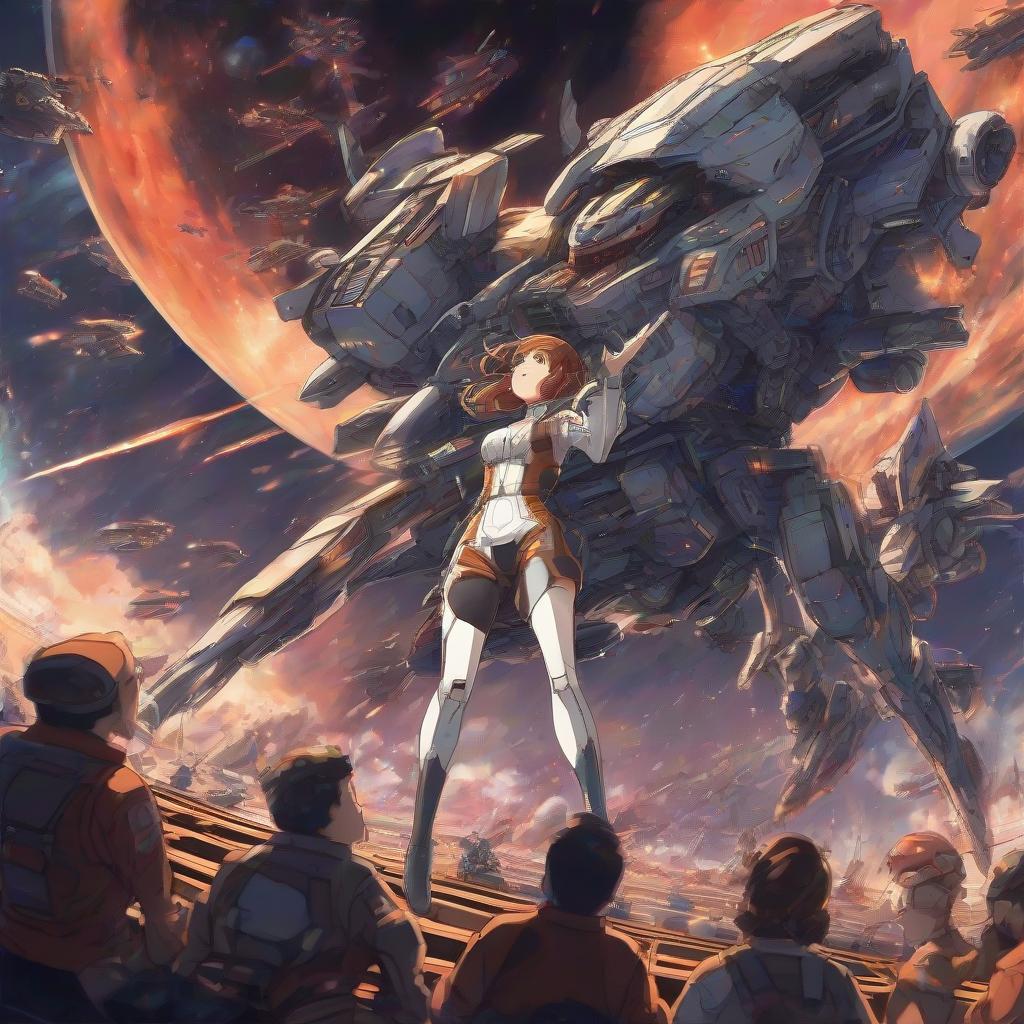
Super Dimension Fortress Macross: Do You Remember Love? 4K Remaster Review
The Super Dimension Fortress Macross: Do You Remember Love? holds a revered place in anime history. Catching the special screening of its 4K remastered version at Anime Expo 2026, I approached it without prior exposure, curious if its legendary status was built on genuine merit or solely nostalgia. Having watched it for the first time in 2026, I now profoundly understand why this film has resonated for over four decades.
We are currently in a golden age where many classic anime titles are making their way back into cinemas and onto Blu-ray, meticulously restored and remastered to present them in their finest possible form. Do You Remember Love? stands as a prime example of this careful preservation. It was only after my initial viewing that I discovered the film is a feature-length condensation of a 36-episode television series. This explains why some characters receive less attention than they might need for certain emotional beats, yet the story unfolds impressively cleanly within its roughly two-hour runtime. It functions as a compelling space opera war film interwoven with a poignant love triangle, all while effectively driving home its core message: culture serves as a unifying force. Every character's journey ultimately contributes to this central theme.
The concept of “culture” within the film is broadly defined, encompassing everything from romance and physical affection to music, entertainment, and everyday human connections, starkly contrasting with military conflict. This breadth is brilliantly explored when several human characters are captured by an alien race, the Zentradi, who are entirely unfamiliar with anything beyond endless war. Their hilarious bewilderment at basic displays of affection between the sexes establishes a simple yet profound concept: culture is both powerful and inherently contagious.
While exposing the aliens to human culture isn't the primary objective for humanity through much of the film – their main goal is survival – the narrative elevates the pursuit of love and a culturally rich life above senseless warfare. This message is delivered with clarity and impact through the climactic clash between human and alien forces. Despite its compressed nature, the story successfully lands its narrative conclusion, though some supporting characters, like Max, Milia, and Roy, primarily serve as thematic tools, even with their spectacular showcase moments.
Our hero Hikaru's growth arc is thoughtfully developed. While his swift shift in affection after his initial encounter with idol singer Lynn Minmay felt a touch rushed, his relationship with Misa Hayase truly nurtures his evolution into the mature leader the film requires by its end. Admittedly, despite her iconic status and pivotal role, Minmay's arc seems to accelerate dramatically towards the climax. Her emotional turnaround near the story's end feels abrupt, as the plot necessitates her return to her initial idol persona. However, a powerful scene where a mature Hikaru confronts her, snapping her out of her emotional stupor, lends a certain earned weight to this transformation.
Do You Remember Love? intelligently zeroes in on the characters most essential to its central message. This approach, while leaving some supporting players feeling less fleshed out, keeps the film remarkably focused despite its ambitious task of condensing an entire television series into a single feature. The film's themes resonate strongly even today, perhaps especially so. Encased within an epic tale of space battles and romantic entanglements is the fundamental idea that culture – the seemingly mundane everyday things we take for granted, like music and human connection – possesses the power to persuade an enemy to cease hostilities. The foundation is laid early with the Zentradi alien scene, where they are utterly flabbergasted by simple affection between two individuals.
What makes Do You Remember Love? so intelligent is its argument that war is not ultimately won by force, despite all its spectacle. The alien races have known only war, and when confronted with novelties like music or romance, they are completely unequipped to process them, while humanity takes these very things for granted. The capture of Hikaru, Misa, and others isn't merely a plot device; it directs the narrative lens squarely on the “culture” we enjoy daily, prompting us to consider how an outside observer would perceive human civilization for the very first time. This framing elevates seemingly ordinary moments into the film’s most crucial ones. Max and Milia’s relationship is not just a romantic subplot, nor is Minmay’s singing merely a rallying cry for the final battle. Both elements powerfully underscore the central message that love, art, and human connection are far more potent than all the military might the alien forces can muster.
Do You Remember Love? achieves an operatic tone, masterfully conveying a sense of grand scale. It boldly lingers on long tracking shots featuring slow, subtle parallax, effectively communicating the vastness of a space fleet or the desolate emptiness of a post-attack Earth. Sometimes, it depicts the tiny insignificance of that very space fleet against the staggering void of space. All these elements collectively contribute to a pervasive sense that the ongoing conflict truly extends to the far reaches of the world the story's players inhabit, and just how small and vulnerable humans are within it. These slower, quieter moments are expertly punctuated by exhilarating aerial combat sequences and shots of epic, large-scale battles, with the shifts between them never feeling jarring. Rather than disjointed, these extremes reinforce one another. These elements culminate beautifully in the final battle, where a dramatically still moment between Hikaru and Minmay is juxtaposed against a massive window overlooking the chaos of the battlefield. Their tiny figures set against colossal space vessels and the backdrop of space create a truly epic atmosphere.
Perhaps the strongest argument for Do You Remember Love?'s status as one of the greats lies in its animation and overall visuals. An incredible level of craftsmanship is evident in countless scenes. The mechanical animation of the transforming combat vehicles in brilliantly choreographed dogfight sequences, combined with Ichirō Itano's iconic missile choreography, is a breathtaking sight. The hand-drawn explosions and visual effects, such as lasers and smoke trails, evoke a genuine nostalgia for the animation techniques of that era. The cinematography also deserves special mention. Establishing shots and compositions are given ample time to breathe, and the film cleverly uses its space setting to present shots in unexpected orientations. The scene of Minmay falling vertically along the pavement after the main battleship has transformed is truly riveting. Some of the most memorable visuals are not even action set pieces but slower, more contemplative shots, like the battleship slowly emerging from darkness before its silhouette becomes recognizable, or the structure of the ancient civilization rising from the water. Perhaps the most striking scene unfolds during the fight between Max and Milia, where the hallway is illuminated solely by the muzzle flashes of their gunshots, mimicking strobe lights.
Do You Remember Love? remarkably manages to feel modern without looking modern. The hand-painted backgrounds are gorgeous, and the character animation is exceptionally expressive. Its enduring quality stems from the fact that real, hand-made animation executed at this caliber does not diminish with age. The scene of Hikaru and Minmay on their date, changing outfits by leaping between holographic platforms, is another reminder of the unique visual tricks achievable only with traditional animation. It genuinely “looks good,” not merely “good for its age.” The 4K restoration itself appeared excellent to my fresh eyes, having never seen the film before. I can confidently affirm that the linework is clean, and the colors are vibrant and clear. I never once felt that Big West had treated this film with anything less than the utmost care and respect. In contrast to other recent remastering projects that employed upscaling tools with disappointing results, there is none of that here. Everything appears crisp, whether in motion or in a still frame.
One regrettable aspect of the screening was an audio issue that produced a heavy echo, making it difficult to confidently assess the film's sound design. While still watchable, it was certainly not the intended presentation. That said, the soundtrack features some excellent pieces. An early dogfight, for instance, is set to energetic rock guitar riffs. Other segments are scored with fitting, standard orchestral background music, though nothing else stands out as particularly remarkable. However, one cannot discuss Do You Remember Love? without mentioning the songs performed by Minmay, the film's beloved idol singer. Sung by Mari Iijima, who also voices Minmay, the song "Do You Remember Love?" was written specifically for the film and is widely recognized as one of the most iconic anime songs of the 1980s.
Do You Remember Love? may not appeal to everyone. If your preference is for nuanced character drama or the slow, intentional character development typically found in television series, the film's compressed narrative might not satisfy that particular desire. However, for anyone who appreciates classic science fiction, exceptional hand-drawn animation, or simply anime history, it is an easy recommendation. Emerging from the screening of this new 4K restoration, I fully comprehended why the film is so highly revered, and it is unequivocally not due to nostalgia. It is because true craftsmanship never fades with time.